
Description
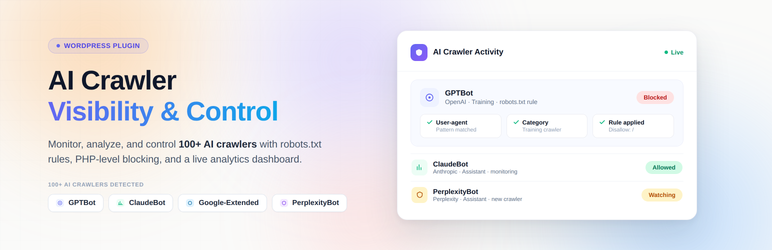
AI Crawlers Visibility, Analytics & Control helps WordPress site owners understand and manage how AI systems access their content. Monitor visits from GPTBot, ClaudeBot, Google-Extended, PerplexityBot, and 78+ known AI crawlers, then choose which bots to monitor, discourage through robots.txt, or block with a PHP 403 response.
The plugin combines AI crawler analytics, AI bot control, and AI discoverability tools in one WordPress dashboard. It includes an AI Visibility Score, llms.txt and llms-full.txt, Markdown for Agents, JSON-LD, downloadable reports, email alerts, and an authenticated REST API.
It works alongside SEO and security plugins. It does not replace traditional SEO, a firewall, or server-level bot protection.
AI SEO, GEO, and AEO for WordPress
Traditional SEO helps search engines index a site. AI SEO, Generative Engine Optimization (GEO), and Answer Engine Optimization (AEO) focus on making content easier for AI crawlers and answer engines to discover and understand.
This plugin supports the technical foundations of AI visibility by helping you:
- Measure which AI crawlers access your content and which pages they request.
- Check discovery, structured-data, and content-readiness signals.
- Publish AI-readable discovery files and Markdown versions of public content.
- Provide machine-readable site identity and article information with JSON-LD.
- Control crawler access without changing the content human visitors see.
No plugin can guarantee inclusion, citations, rankings, or traffic from ChatGPT, Claude, Gemini, Perplexity, or other AI services.
Why monitor AI crawlers on WordPress?
AI companies use automated AI crawlers to index, train on, or retrieve website content. Common examples include GPTBot (OpenAI), ClaudeBot (Anthropic), Google-Extended (Google), Bytespider (ByteDance), CCBot (Common Crawl), PerplexityBot, and many others.
With this AI crawlers plugin you can:
- See which AI crawlers visit your site and which pages they request.
- Compare AI bot traffic across date ranges and spot trends over time.
- Block AI crawlers with robots.txt rules or PHP-level 403 responses.
- Keep logs for compliance, debugging, and content licensing decisions.
- See a 7-day crawler summary on the WordPress admin dashboard.
How it works
- Enable crawler tracking and choose how long activity logs should be retained.
- Review crawler trends, top bots, most-crawled pages, and recent requests.
- Use robots.txt or optional PHP blocking for crawlers you do not want accessing your content.
- Run an AI Visibility Score scan and enable the discoverability features that fit your site.
AI crawler analytics dashboard
Understand which AI systems are interested in your site instead of relying on guesswork.
- Dashboard with total requests, unique AI crawlers, pages crawled, and blocked attempts.
- Charts for AI crawler requests over time and traffic by bot category.
- Top AI crawlers and most-crawled pages tables with period comparison.
- Recent AI crawler activity log with filters for bot, HTTP status, and content type.
- Download CSV analytics reports for preset or custom date ranges.
- Blocked-attempt logging when PHP blocking is enabled.
AI Visibility Score
Find technical signals that can limit AI discovery and get prioritized recommendations for improvement.
- Analyze any page or your entire site for AI readiness.
- 28 automated checks across discovery, structured data, content structure, and technical signals.
- 0–100 score with letter grade and prioritized recommendations.
- Site-wide batch scan, scan history, comparison diff, and PDF export.
AI discoverability: llms.txt, Markdown, and JSON-LD
- Auto-generate
/llms.txtand optional/llms-full.txtfor AI systems. - Choose public post types, set URL limits, and include or exclude individual content.
- Exclude content by URL pattern and automatically exclude noindex content.
- Respect noindex metadata from Yoast SEO, Rank Math, All in One SEO, SEOPress, and Genesis.
- Regenerate discovery files when content is published or on a schedule.
- Optionally add
LLMs:andLLMs-full:references to robots.txt. - Serve
.mdURL endpoints for public content and taxonomy archives. - Respond to
Accept: text/markdownrequests from compatible AI agents. - Output Organization, WebSite, and optional Article JSON-LD with AI discovery pointers.
WooCommerce AI Search Optimization
When WooCommerce is active, optimize products for AI search engines:
- Include products in
llms.txtwith price, stock status, ratings, and attributes. - Variable product price ranges and sale price display.
- Product Markdown endpoints with YAML commerce frontmatter (SKU, price, availability).
- Optional Product JSON-LD schema (skipped when major SEO plugins already output it).
- Product data panel tab: exclude from AI and set a short AI description.
- HTTP
Linkheader pointing to/llms.txt(rel="ai-content-index"). - Product-focused Visibility Score checks (schema, SKU, price).
78+ built-in AI crawlers
- Pre-configured detection for major AI, search, and scraper bots.
- Category labels (training, search, assistant, agentic, scraper, and more).
- Per-crawler info with user-agent pattern details.
- Enable or disable monitoring for individual AI crawlers.
- Includes crawlers associated with OpenAI, Anthropic, Google, Perplexity, Meta, Amazon, Apple, ByteDance, Common Crawl, and others.
Custom AI crawler detection
- Add your own user-agent patterns for bots not in the built-in list.
- Assign company name and category for consistent reporting.
robots.txt control for AI crawlers
Publish clear crawler preferences and identify bots that continue visiting after being disallowed.
- Add Disallow rules for selected AI crawlers.
- Bulk templates to disallow or allow entire categories (training, scraper, and more).
- Compliance monitor shows top non-compliant crawlers that still visit.
- Rules are appended to your WordPress robots.txt output.
- Live preview before you publish changes.
Block AI crawlers with PHP (403)
robots.txt communicates a preference; PHP blocking enforces access control at the WordPress application level.
- Hard-block selected AI crawlers before WordPress serves a response.
- Block specific IP addresses with the same 403 PHP response.
- Customize the plain-text message returned to blocked bots (since 1.1.0).
- Blocked requests are logged in the AI crawler analytics dashboard.
- Works alongside robots.txt for stronger enforcement when needed.
Data management
Crawler activity is stored in your WordPress database, giving you control over retention and deletion.
- Configurable log retention (7 days to 1 year, or keep all data).
- Optional delete-all-data action from the admin.
- Delete plugin data on uninstall (optional setting).
- Multi-select crawler, category, HTTP status, and content-type activity filters.
- Download reports for preset or custom date ranges.
Reports and integrations
- Daily, weekly, or monthly HTML email reports with configurable recipients and alert types.
- Email summaries cover crawler activity, traffic changes, blocked attempts, new crawlers, and robots.txt non-compliance.
- Test email delivery and view the next scheduled report from the Reports page.
- Authenticated REST API for analytics summaries, recent activity, CSV exports, visibility scans, and blocked attempts.
- Professional report emails include key metrics, the top crawler, and most-crawled pages.
Clean admin experience
- WordPress admin menu: AI Crawlers
- Redesigned UI with grouped sidebar navigation and dark mode.
- Dashboard, Crawlers, Control, Visibility Score, Reports, and Settings in one place.
- Built for site administrators — no code required.
Who is this plugin for?
- Bloggers and publishers who want to know when AI crawlers access their articles.
- Business and marketing sites tracking AI bot traffic to key landing pages.
- Developers and agencies managing AI crawler policy across client WordPress sites.
- Site owners exploring robots.txt and PHP options for AI crawler control.
Privacy and data ownership
- AI crawler activity logs are stored locally in your WordPress database.
- The analytics dashboard tracks detected crawler requests, not general human visitor analytics.
- Log retention and deletion are controlled from the plugin settings.
- Scheduled reports are sent through the standard WordPress
wp_mail()function. - Core crawler monitoring does not require a separate analytics account.
Screenshots


Installation
- Upload the
aI-visibility-suitefolder to/wp-content/plugins/, or install via the WordPress Plugins screen. - Activate AI Crawlers Visibility, Analytics & Control through the Plugins menu.
- Go to AI Crawlers Crawlers in the WordPress admin sidebar.
- Enable crawler tracking and choose your preferred data retention period.
- Open AI Crawlers Dashboard to view AI crawler traffic after bots visit your site.
FAQ
-
How do I monitor AI crawlers on WordPress?
-
Install and activate the plugin, enable crawler tracking under AI Crawlers Crawlers, then open AI Crawlers Dashboard. You will see stats, charts, top AI crawlers, recent requests, and blocked attempts once AI bots visit your site.
-
Which AI crawlers does this plugin detect?
-
The plugin ships with 78+ built-in AI crawlers including GPTBot, ClaudeBot, Google-Extended, Amazonbot, Bytespider, CCBot, PerplexityBot, Applebot-Extended, Meta-ExternalAgent, and more. You can also add custom user-agent patterns for bots not in the list.
-
How do I block AI crawlers?
-
Blocking is opt-in. Use robots.txt rules under AI Crawlers Control to disallow specific AI crawlers, or enable PHP blocking to return a 403 response. Blocked attempts appear in the analytics dashboard.
-
Does this plugin block AI crawlers automatically?
-
No. Tracking can be enabled when you turn it on, but blocking is always opt-in. Configure robots.txt rules or PHP blocking per crawler from the AI Crawlers Control screen. You can also set a custom 403 message for PHP-blocked crawlers (since 1.1.0).
-
Will blocking AI crawlers hurt my SEO?
-
Blocking AI training or retrieval crawlers is separate from traditional search engine indexing. Disallowing GPTBot or similar bots in robots.txt does not block Googlebot or Bingbot by default. Review your robots.txt preview and allow crawlers you still want to reach your site.
-
Does the plugin modify my physical robots.txt file?
-
No. robots.txt rules are injected via the WordPress
robots_txtfilter, which is the standard approach on WordPress sites. Use the live preview in settings to see the effective output. -
What is the difference between robots.txt control and PHP blocking?
-
robots.txt publishes a request that compliant crawlers should follow, but it does not enforce access. PHP blocking returns an HTTP 403 response before WordPress serves the requested content. You can use robots.txt alone or combine it with PHP blocking for selected crawlers that require stronger control.
-
What is the AI Visibility Score?
-
The AI Visibility Score analyzes a page or your site across 26 discovery, structured-data, content-structure, and technical checks. It returns a score from 0 to 100, a letter grade, and prioritized recommendations. The score measures technical readiness; it does not guarantee AI citations or rankings.
-
What are llms.txt and llms-full.txt?
-
llms.txt is an AI-readable index of selected public content. The optional
llms-full.txtcan provide a fuller content representation. The plugin can generate both, update them when content changes or on a schedule, reference them in robots.txt, and exclude noindex or manually excluded content. -
Does this replace Yoast SEO, Rank Math, or another SEO plugin?
-
No. This plugin focuses on AI crawler monitoring, access control, and AI discoverability. It is designed to work alongside an SEO plugin. Its llms.txt generator can respect noindex metadata from Yoast SEO, Rank Math, All in One SEO, SEOPress, and Genesis.
-
Where is AI crawler data stored?
-
Detected crawler activity is stored in your WordPress database. You can choose a retention period, delete collected data from the plugin, and optionally remove plugin data during uninstall.
-
Will crawler monitoring slow down my site?
-
The plugin checks request user-agent strings and records requests that match enabled AI crawlers. It does not run general human-visitor analytics. Database growth depends on crawler activity, so choose an appropriate retention period for busy sites. Full-page caches or reverse proxies that serve requests before WordPress runs may prevent those requests from being logged.
-
Can I export AI crawler logs?
-
Yes. Use Download report on the Dashboard or Reports page. The Reports page supports preset periods and a custom From/To date range.
-
How do scheduled email reports work?
-
Open AI Crawlers Reports, add one or more recipient addresses, choose daily, weekly, or monthly delivery, and select the alerts to include. Monthly reports cover the latest 30 days. You can send a test email and view the next scheduled delivery. WordPress sends reports through
wp_mail(), so SMTP configuration may be needed if your server does not provide reliable mail delivery. -
Does the plugin provide a REST API?
-
Yes. Version 1.2.0 adds authenticated endpoints under
moai-av/v1for analytics summaries, recent activity, CSV exports, visibility scans, and blocked attempts. Requests require a logged-in administrator with themanage_optionscapability. -
Is this plugin compatible with caching and security plugins?
-
Yes. AI crawler detection runs on front-end requests. PHP blocking executes early in the request lifecycle. As with any blocking plugin, test on staging if you use aggressive caching or a reverse proxy.
Reviews
There are no reviews for this plugin.
Contributors & Developers
“AI Crawlers Visibility, Analytics & Control” is open source software. The following people have contributed to this plugin.
Contributors
Translate “AI Crawlers Visibility, Analytics & Control” into your language.
Interested in development?
Browse the code, check out the SVN repository, or subscribe to the development log by RSS.
Changelog
1.3.0
- Added WooCommerce AI Search Optimization under Discoverability (optional when WooCommerce is active).
- Enriched product entries in llms.txt with price, stock, ratings, attributes, and variable/sale pricing.
- Added product Markdown endpoints with commerce YAML frontmatter.
- Added Product JSON-LD schema (auto-skipped when Yoast, Rank Math, AIOSEO, or SEOPress already output Product schema).
- Added Product data AI Visibility tab to exclude products or set an AI short description.
- Added HTTP Link header to llms.txt (
rel="ai-content-index"). - Added product Visibility Score checks for Product schema, SKU, and price.
1.2.1
- Added site-wide Visibility Score scan from the Visibility page with batch progress and per-URL results.
- Added 5 built-in crawlers: Cotoyogi, ExaBot, VelenPublicWebCrawler, Omgilibot, and Thinkbot (78 total).
- Added a new AI agent category for custom crawlers, filters, and bulk robots templates; reclassified Google-Agent, Devin, FirecrawlAgent, and NovaAct.
- Expanded AI Visibility Score from 26 to 28 checks (semantic HTML5 landmarks and JavaScript-dependent content detection).
1.2.0
- Added a complete Reports page with report downloads, email delivery settings, schedule status, test email support, and REST API information.
- Added scheduled daily or weekly HTML email reports with configurable recipients and alert types.
- Added email alerts for crawler activity, traffic changes, blocked attempts, newly detected crawlers, and robots.txt non-compliance.
- Added professional grayscale email summaries with key metrics, the top crawler, and most-crawled pages.
- Added authenticated
moai-av/v1REST endpoints for analytics summaries, recent activity, CSV exports, visibility scans, and blocked attempts. - Added compact multi-select crawler, category, HTTP status, and content-type filters to Recent Activity.
- Added downloadable reports with preset periods and custom From/To date ranges.
- Improved report settings with immediate schedule-status updates and clearer admin notices.
- Added a graceful error when the server is missing the PHP DOM/XML extension required by Visibility Score, preventing a fatal error.
1.1.2
- Added Blocked IP Addresses under AI Crawlers Control — block specific IPs with PHP 403.
- Added taxonomy markdown archives for Markdown for Agents (categories, tags, and other public taxonomies).
- Added 5 built-in crawlers: Timesbot, TavilyBot, Andibot, Brightbot, and NovaAct (73 total).
- Expanded AI Visibility Score from 19 to 26 checks (llms-full.txt, Markdown delivery, noai/noimageai, Twitter cards, HTML lang, heading hierarchy, image alt text).
1.1.1
- Added robots.txt compliance monitor — top non-compliant crawlers with one-click PHP block.
- Added category bulk templates to disallow or allow entire crawler categories at once.
- Added WordPress admin dashboard widget (miniOrange AI Crawlers) with last-7-days activity summary.
1.1.0
- Added customizable PHP 403 block message under AI Crawlers Control PHP blocking.
- Blocked AI crawlers receive your saved plain-text response instead of a generic “Access denied” (sanitized, 500-character limit).
- Added Discoverability page with llms.txt generator, Markdown for Agents, and JSON-LD schema output.
- llms.txt supports post-type filters, max URLs, llms-full.txt, auto-regenerate on publish, and scheduled cron.
- llms.txt robots.txt integration — optional
LLMs:andLLMs-full:references in robots.txt. - llms.txt content controls — exclude by URL pattern, manual include/exclude posts, and post search in admin.
- Markdown endpoints serve
/{slug}.mdplus content negotiation for AI agents. - JSON-LD includes site identity, AI discovery pointers, and optional Article schema.
- Visibility Score — improved robots.txt detection (physical and virtual files, no HTTP loopback required).
- Visibility Score — improved XML sitemap detection for WordPress core, Yoast SEO, and Rank Math.
- Fixed Visibility recommendation link for robots.txt to open AI Crawlers Control.
1.0.2
- Redesigned admin UI with modern sidebar navigation, dark mode, and refreshed dashboard layouts.
- Added AI Visibility Score tab with single-URL and site-wide scanning.
- Added 19 readiness checks, recommendations, scan history, diff, and PDF export.
- Added visibility scan database tables.
1.0.1
- Added crawler analytics dashboard with date ranges, filters, period comparison, and charts.
- Added AI crawler monitoring, custom crawlers, robots.txt rules, and PHP blocking (403).
- Added grouped side navigation for Analytics and AI Crawlers admin pages.
- Added miniOrange menu and navbar branding.
- Expanded built-in AI crawler list and crawler info tooltips.
1.0.0
- Initial release with MVC architecture and free/premium codebase structure.
- Added admin dashboard foundation.